
Start an Oxnard Residents Directory Search
Begin with the strongest fact already in hand. A full street address is useful for the Ventura County Tax Collector, Assessor, and County View parcel tools. A person’s name fits the Recorder index, court party search, license systems, or a directory year. An approximate date points toward vital records, census schedules, newspapers, and the Oxnard Public Library Local History Room. The same name can belong to several people, so keep the date, place, role, and spelling with every result.
The first pass should stay broad. Find an APN from the address, compare the physical situs with the tax mailing address, and then follow the recorded owner or grantee. For a person, write down middle initials, compound surnames, former names, and likely spelling variants before searching. A source that names an owner, voter, case party, licensee, or mail recipient does not by itself prove that the person lived at an address.
- Use the Ventura County tax search or County View to turn an address into an APN.
- Compare the parcel’s situs address and mailing address in the Ventura County Assessor Property Search.
- Search the Recorder Self-Service index for grantor and grantee names, then inspect the underlying document.
- Use the proper court, vital, license, or voter channel when the question is about one person rather than a parcel.
- For an older household, pair a directory or newspaper year with a census, deed, Sanborn sheet, or obituary instead of treating one listing as proof.
Oxnard Residents Directory: Records Offices
Oxnard is wholly within Ventura County, but Ventura is the county seat. General recorder, assessor, tax, elections, and court-counter work is centered at the Government Center in Ventura. Oxnard has important local channels too, including the City Clerk, Building and Engineering, Planning, Police Records, and the Probate and Juvenile Courthouse. The office matters because each custodian keeps a different kind of resident evidence.
Ventura County Recorder
800 S. Victoria Ave.
Ventura, CA 93009
(805) 654-3665 / 3666
Clerk-Recorder and Registrar
Ventura County Assessor
800 S. Victoria Ave., L#1270
Ventura, CA 93009
(805) 654-2181
Property Search
Ventura Elections Division
800 S. Victoria Ave., #L1200
Ventura, CA 93009
(805) 654-2664
My Voter Status
The Recorder’s public index is a card-catalog guide, not the deed image itself. The Assessor connects an APN to taxable property and an assessee, while County View supplies parcel geometry and attributes. My Voter Status is a personal authenticated check, not an open list of Oxnard voters. For a city-held file, the Oxnard Public Records route is the starting point under the California Public Records Act.
Oxnard Residents Directory: Address-to-APN Trail
An APN is the Assessor’s indexing number for a parcel. It is more stable than a street string when a name is shortened, a unit is omitted, or a neighborhood crosses a postal boundary. The Tax Collector’s WebTax search accepts an address or APN, and County View accepts an APN, graphical selection, or Assessor situs autocomplete. Once the parcel is located, record the legal description, tract or map, and situs address before looking for a person.
County View’s public parcel layer exposes APN and APN10, book, page, block, parcel, tract, map, acreage, zoning, values, transfer date, sale price, improvement size, and several structure flags. It does not expose owner or owner-mailing names. That omission is useful: a map click is a parcel lead, not a resident result. Follow the APN into the Assessor and then the Recorder, where a grantee receives an interest and a grantor conveys one.
- APN
- The Assessor’s parcel number used to index property records and maps.
- Situs address
- The physical location of the parcel, distinct from the address used for tax mail.
- Legal description
- The recorded lot, block, tract, or other land description that helps connect deeds across address changes.
- Roll
- An official list, such as an assessment or voter file, created for a defined public purpose.
The Ventura County Assessor Property Search is the next stop after the address-to-APN bridge.
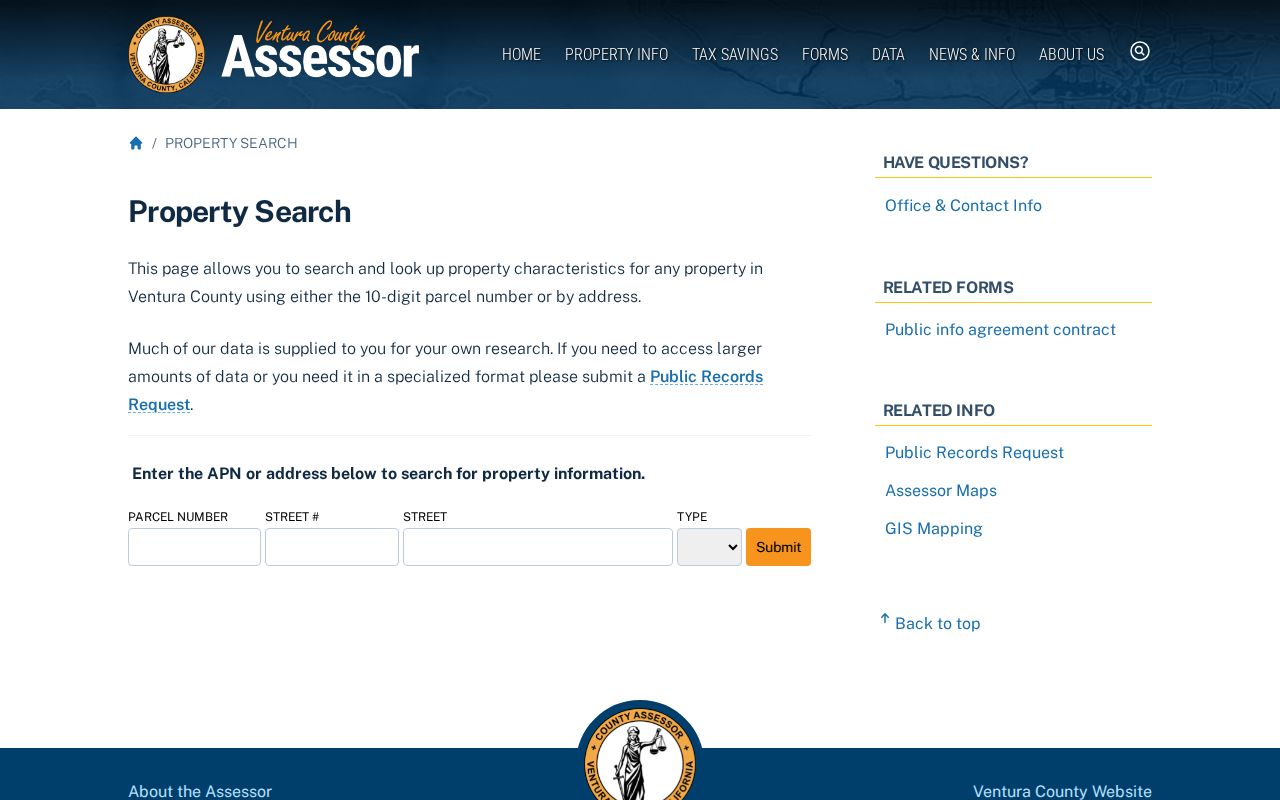
The property-search entrance helps tie the parcel number to the correct county record, but the displayed owner role still does not prove occupancy.
For parcel research, save the APN and legal description together. Matching situs and mailing addresses still does not prove that every person at the property is an owner or occupant.
Oxnard Residents Directory: Recorder Index Clues
Ventura County’s Recorder Self-Service entrance directs a researcher to the real-estate index for filings in which a party is a grantor or grantee. Search spelling variants and do not assume the display name is the whole story. A deed, trust deed, lien, release, map, or title decree may connect a name to an APN or legal description. A deed of trust is financing evidence, not necessarily a title transfer. Certified copies and document images remain a separate step from the index.
Recorder counter access matters when the online application is unavailable or a result needs a clearer image. Appointments are used for county service, and kiosks operate at Ventura and Thousand Oaks. The accessible official material does not publish a firm online cutoff or every image fee, so a search that ends at the web index should move to the Recorder rather than assume that no older record exists.
| Party role | Grantor conveys an interest; grantee receives one. |
|---|---|
| Useful keys | Name variant, document number, recording date, APN, and legal description. |
| Record types | Deeds, deeds of trust, liens, releases, maps, leases, and related official instruments. |
| Proof step | Read the document image or obtain a copy from the custodian; do not rely on an index line alone. |
Oxnard Residents Directory: Why There Is No Single Roll
An owner appears in a property record because a tax or title system needs that role. A court party appears because a case has a named participant. A voter appears through a regulated election record. A directory entry reflects a publication date. These statuses overlap, but they are not interchangeable. The strongest Oxnard residents directory search is an evidence chain that keeps each role separate.
| Official source | Useful answer | Do not infer |
|---|---|---|
| Assessor and GIS | Parcel, assessee, situs, value, and map clues | Complete household or occupancy |
| Recorder | Recorded party and transfer relationship | Every person who lived there |
| Voter channel | Your own status, or restricted file evidence for a qualifying use | An open street roster |
| Directory or census | A dated household or address snapshot | Continuous residence between editions |
California Elections Code §2194 and Government Code §7924.000 limit voter-file disclosure to qualifying election, scholarly, journalistic, political, or governmental purposes. A third-party search box cannot turn that protected channel into an anonymous block list. Use a custodian record for the conclusion it can support, then stop when the source reaches its legal or factual boundary.
The California My Voter Status form is a personal, authenticated lookup rather than an open Oxnard resident list.
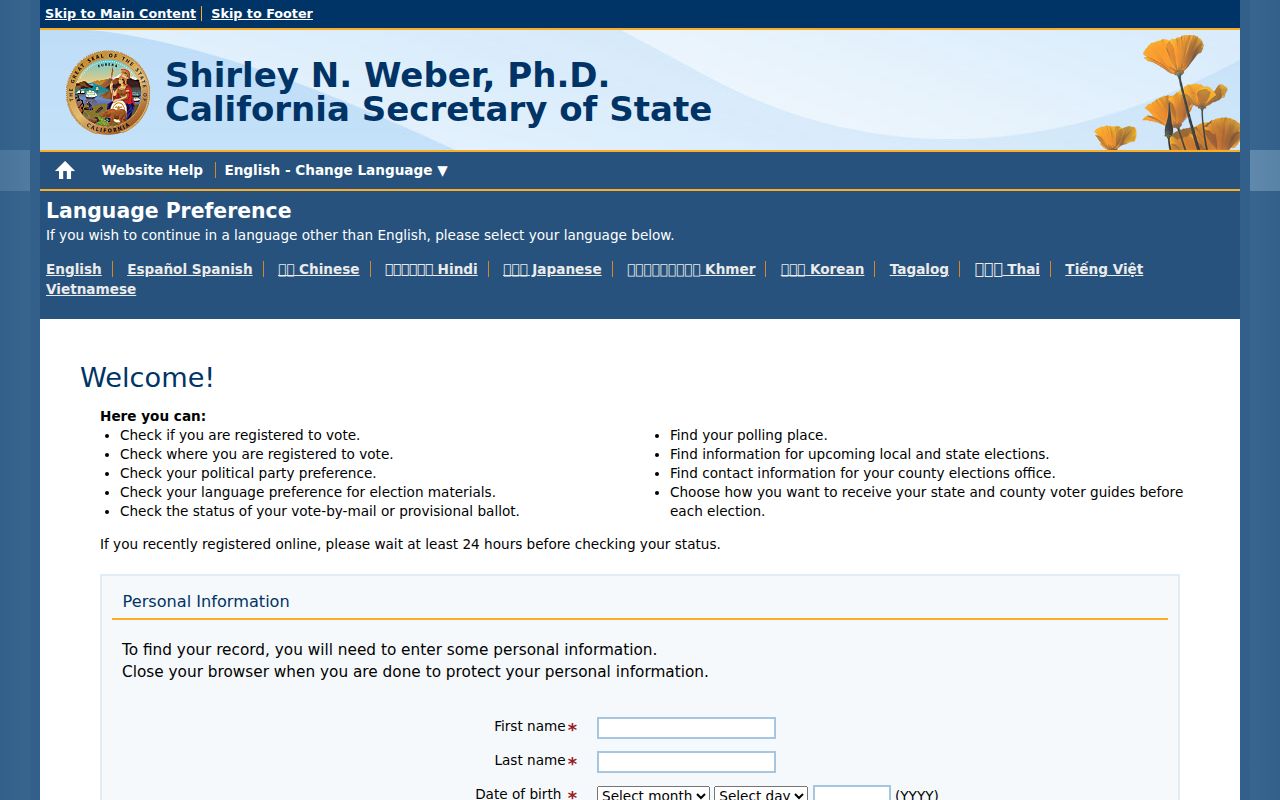
The identity fields protect the individual check and mark the boundary between personal status and a qualifying voter-file request.
Current Oxnard Resident Directory Sources
Current directory-like sources are best read as narrow tools. The Assessor and Recorder help with property relationships. The City’s business tax certificate list shows business names and addresses, refreshed every seven business days, but a business presence is not a household. Neighborhood Services publishes civic boundaries and chair contacts, not member lists. The table keeps those limits visible.
| Source | Who or what it lists | Keeper | Access |
|---|---|---|---|
| Property search and parcel GIS | Parcels, assessee clues, situs, values, maps | Ventura County Assessor and GIS | Online; counter fallback |
| Recorder real-estate index | Grantors, grantees, instruments, dates | Ventura County Clerk-Recorder | Online entrance and kiosks |
| My Voter Status | The requesting voter’s registration result | California Secretary of State | Free, authenticated |
| Business Tax Certificate list/map | Business names and address data | City of Oxnard | Public list/map |
| Neighborhood Locator | Boundaries, activity, chair or role contact when supplied | Oxnard Neighborhood Services | Public civic resource |
When the question narrows to one person, use the court, vital, license, or business channel that created the record. The one-person workflow on the Oxnard resident lookup page explains why a matching name still needs dates, roles, and a second source.
A public credential can add a narrow affiliation clue. The California Department of Consumer Affairs advanced license search supports board, license, name, city, county, status, and discipline filters.
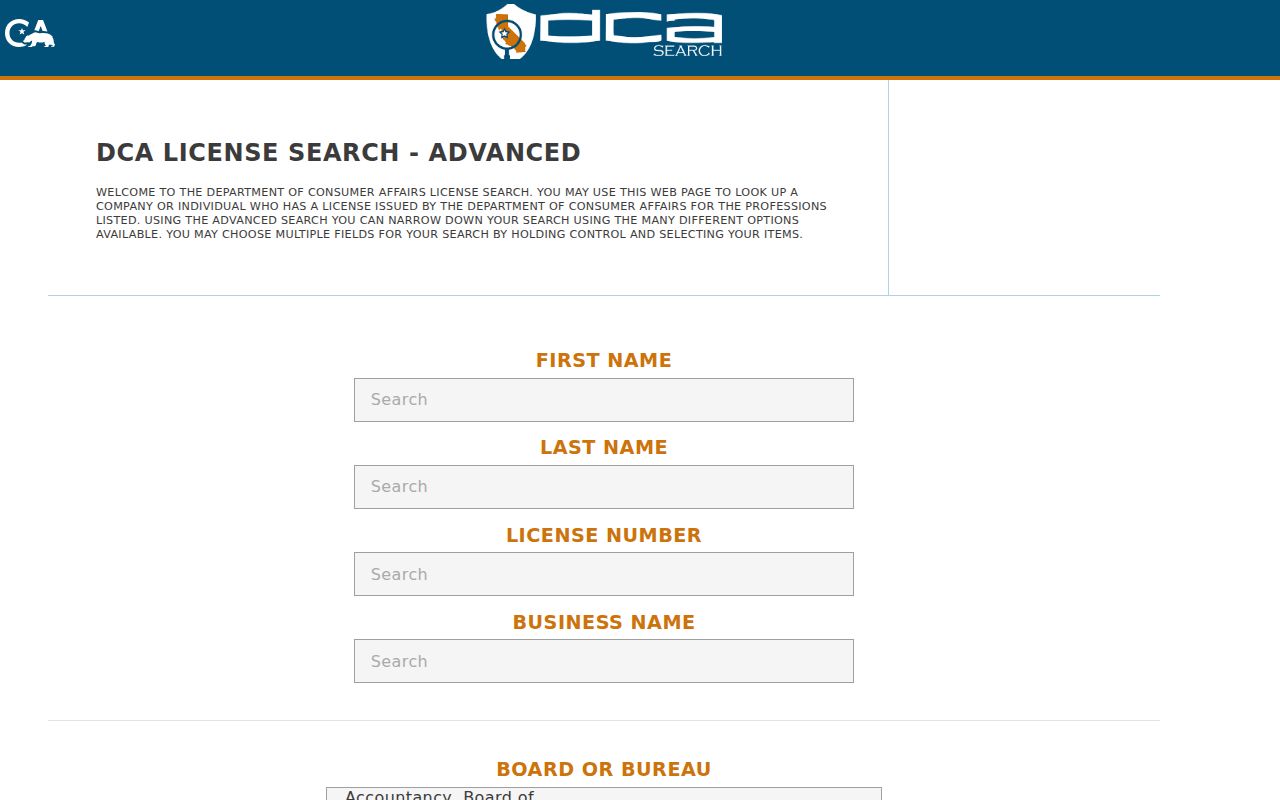
A license result can support a credential or public practice record, not a private home address or a conclusion about where a person lives.
The Ventura County Sheriff inmate search is another narrow lookup for current custody information, not a general resident roll.
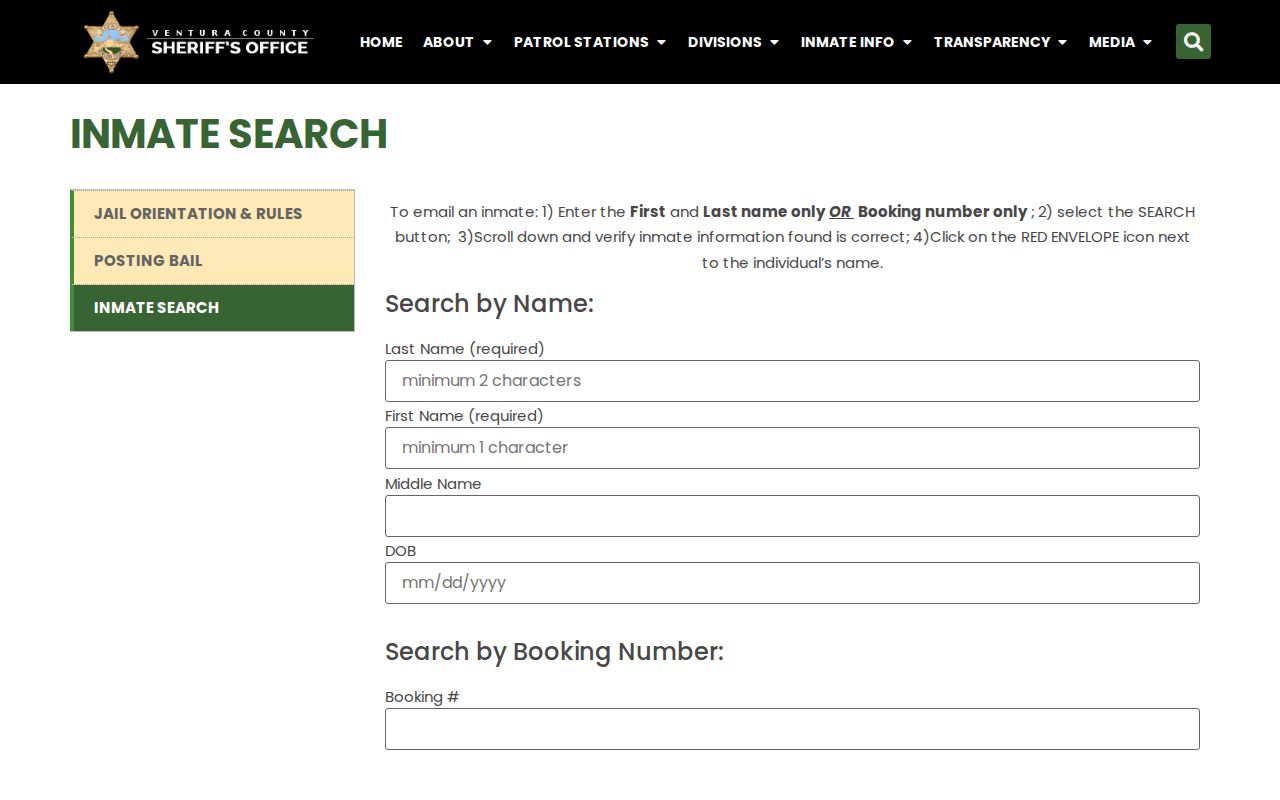
The Sheriff form uses a name or booking number route and should be read only for the custody information it publishes.
For a statewide custody question, use the California CDCR Incarcerated Records and Information Search; it is separate from the Ventura County Sheriff jail search.
Oxnard Residents Directory: Court Timelines
Ventura Superior Court does not offer one uniform online name search. The Case Inquiry page routes Civil, Probate and Small Claims, Family, Criminal, and Traffic to separate systems. Family cases begin entering the online system on September 1, 1991, municipal criminal and traffic entries begin January 1, 1989, and Superior Court criminal entries generally begin in 1995. Staff searches for unlimited-jurisdiction records can reach 1873, often through microfilm, while limited-jurisdiction searches reach seven years.
The Ventura Public Access landing page requires an account before detailed case access. The published controls include Case Access, Login Now, Create an Account, Criminal First Name, Criminal Last Name, Criminal Case Number, and Traffic Citation Number. Remote access remains limited by California Rules of Court 2.501 and 2.503. An absent web hit therefore needs a Records Department or public-terminal check, not a conclusion that no case exists.
| Route | Search key | Local coverage note |
|---|---|---|
| Criminal | First and last name, or case number | Municipal from 1989; Superior entries generally from 1995 |
| Traffic | Citation number | Citation-led, not a general name roll |
| Family | Party or case inquiry after login | Substantial entry from September 1, 1991, with incomplete older coverage |
| Staff or terminal | Name or known case number | Unlimited-jurisdiction records can reach 1873; no more than five cases per transaction |
A record request can be mailed, emailed, or made in person through the court’s VN266 process. The form says searches usually take five to seven business days. It lists a $15 search fee when staff time exceeds ten minutes, $0.50 per copied page, and separate certification, authentication, exemplification, and audio charges. Use the current form for the exact request and delivery choice.
The Ventura Superior Court case-inquiry page is the official route to the separate civil, family, probate, criminal, and traffic systems.
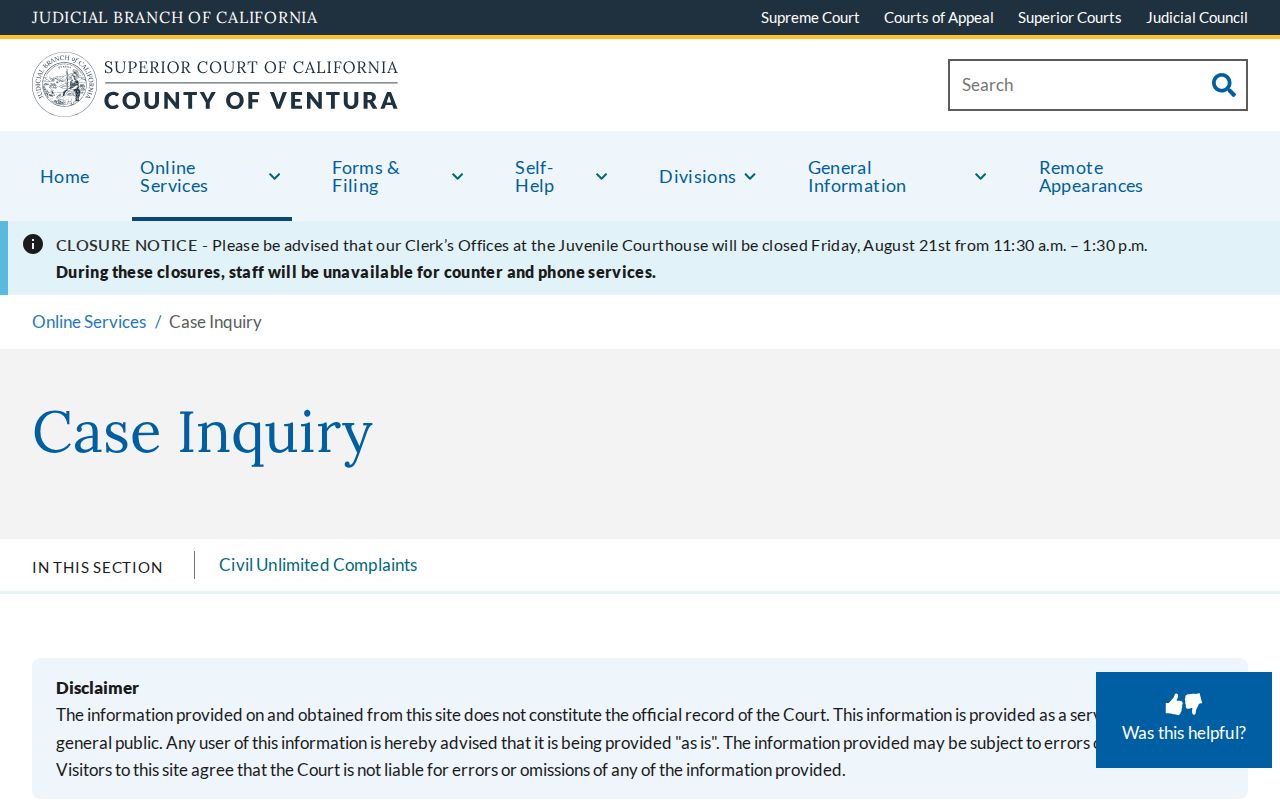
The court landing route shows why a missing online result may require the Records Department or a public terminal rather than a new name variant alone.
For an image-led view of the public access route, see the Ventura Public Access portal.
Oxnard Residents Directory: Two Vital Custodians
The Ventura County certificate guidance places county birth, death, and marriage coverage in 1873. The current and immediately prior year can also run through Ventura County Public Health Vital Records. California Department of Public Health records begin in July 1905 for statewide birth and death channels, with specified marriage and divorce ranges. County in-person service, CDPH mail forms, and independent electronic vendors are different access routes, not interchangeable copies.
| Record | Coverage and route | Access point |
|---|---|---|
| Birth | Ventura County 1873-present; CDPH statewide from July 1905 | VS111, county office, or state mail |
| Death | County record or CDPH statewide channel from July 1905 | VS112 or county route |
| Public marriage | County record; CDPH selected years from 1905 forward | VS113-A or county route |
| Confidential marriage | County Clerk that issued the license | Party or court-order access |
| Divorce | Superior Court decree; CDPH index for 1962-June 1984 | Court request or CDPH route |
California uses an authorized-versus-informational copy distinction rather than a simple genealogy closure formula. An authorized copy requires a qualifying relationship or legal authority and a sworn statement for mailed requests. Anyone may request a certified informational copy of many birth or death records, but it is marked as not valid to establish identity. The CDPH 2026 fees listed in the research are $31 birth, $26 death, $19 public marriage, and $18 divorce index certificate. A no-record search keeps the fee and produces a Certificate of No Public Record.
Historical Oxnard Resident Directories
Past residents require a dated source. Verified material includes a 1929 Ventura County Directory held by the Museum of Ventura County, NARA holdings for 1930-31 and 1934, a FamilySearch catalog entry for 1941-42, Polk’s Ventura County Directory for 1961, and scattered Oxnard city-directory scans through 1980. Local telephone books cover listed names and addresses in runs from 1947 through 1963. No source supplies a clean annual Oxnard run.
The Oxnard city directory collections page keeps the shelf details and gaps together. For a short home-page view, a directory can place a name, occupation, and address in one publication year. A street guide or numerical telephone section may find an address first. Newspapers, census schedules through 1950, Sanborn maps, deeds, and obituaries fill different gaps.
There is a human reason to avoid treating a directory as a complete roll. MVC’s 93-year Oxnard Press-Courier microfilm run can add marriage, school, business, social, and obituary notices when a directory omits women, children, renters, or migrant workers. The collection is held in an archive, not exposed as a single online residents directory.
Oxnard’s Library Holds the Local Clues
The Oxnard Public Library Local History Collection sits in the Special Collection Room at the Main Library, 251 South A Street. Visits are by appointment, generally Wednesdays from 1:30 to 5:30 p.m., and a librarian assists with local research. The room is noncirculating and currently has no printing. Bring a prepared name, address, and year list, then use a camera or notebook for citations and shelf notes.
The collection’s custody reflects the city’s growth. The library opened in a Carnegie building in 1907, remained a city library when the county system formed in 1915, moved to C and Second in 1963, and reached the present A Street building in 1992. A 2025 collection policy emphasizes physical, digital, and electronic material about the Oxnard Plains and permits significant family histories. Exact city-directory shelf years are not published, so staff confirmation is part of a sound search.
For the archive side, the Museum of Ventura County Research Library and Archives holds county maps, photos, newspapers, manuscripts, oral histories, incorporation files, and family papers. Its collections are being conserved and digitized. Together, the library and museum explain why historical resident records may be in a room, a reel, a scan, or a finding aid rather than one searchable page.
For a visual starting point, the Museum research collections describe the archive’s county scope.
When Oxnard Records Need a CPRA Request
The California Public Records Act, Government Code §§7920.000-7931.000, opens nonexempt records held by the City of Oxnard and county agencies. Under §7922.535, an agency generally has 10 calendar days to determine whether it holds responsive records, with a possible written extension of no more than 14 days for unusual circumstances. Inspection is ordinarily free, while copies are charged under the governing fee or direct duplication rule.
Start with published agendas, permit status, maps, and request portals. For older property evidence, Oxnard’s Building Records Research form asks for requester contact details, a record address, property type, purpose, and the exact record types needed. Choices include site or plot plan, floor plan, structural details, foundation plan, Historic Property Street File, sign structure, elevations, or another specified record. Recent permit data covers the current and preceding four calendar years. Older work may take 7-14 working days, and plan-copy permission can take 30 days.
Fallback rule. If an online result stops short, name the address, APN, date range, and record type in a focused request. The custodian can confirm whether the record exists and whether an exemption applies.
The county’s records warehouse manages more than 70,000 containers and 500,000 tracked folders. That scale explains why a counter request, local librarian, court Records Department, or records act request may produce evidence that a public search box does not show.
Oxnard Names, Streets, and ZIPs Shift
Search quality depends on local naming history. Spanish compound surnames may be indexed as one name, two names, initials, or a spacing variant. Try both components, accents and no accents, hyphenated and open forms, plus spouse or business names in historical records. For an address, begin with the normalized USPS form and then try the local situs form without an apartment or unit.
Part of Colonia Road became Camino de la Raza in 1992 and Camino del Sol in January 1994. A record from the early 1990s can be missed if only the modern street name is searched. Keep the date and the period street name with the document. The same care applies to ZIPs: USPS delivery geography, city jurisdiction, planning neighborhoods, and neighborhood councils are separate lenses.
| Physical parcel | Situs address and APN in county property systems. |
|---|---|
| Postal route | USPS ZIP and mailing city used for delivery. |
| Planning lens | Oxnard’s eight communities and 56 planning neighborhoods. |
| Civic lens | Neighborhood Services’ 52 predefined neighborhoods and councils. |
When those labels disagree, use the city and county maps to confirm jurisdiction and let the legal description carry the historical chain. A postal “Oxnard” line is not, on its own, proof that a parcel lies inside the incorporated city.
Privacy Lines around an Oxnard Lookup
California protects more than it publishes. DMV address data is closed under federal and state rules. Voter releases exclude driver-license or state-ID numbers, the last four digits of a Social Security number, unique identifiers, and signatures. Safe at Home offers qualifying participants a substitute address, mail forwarding, and confidential voter registration, but it cannot erase information that was already public.
California’s 2026 DROP program gives residents one free request to registered data brokers, with a DROP ID for status. It changes broker access, not the underlying county deed, court, tax, or vital record. A record trail should serve lawful family history, reconnecting, estate research, property curiosity, civic understanding, or personal safety. Do not publish a protected address or use a name and location to stalk, threaten, intimidate, or harass anyone.
The California DROP privacy portal is the state route for one request to covered data brokers.
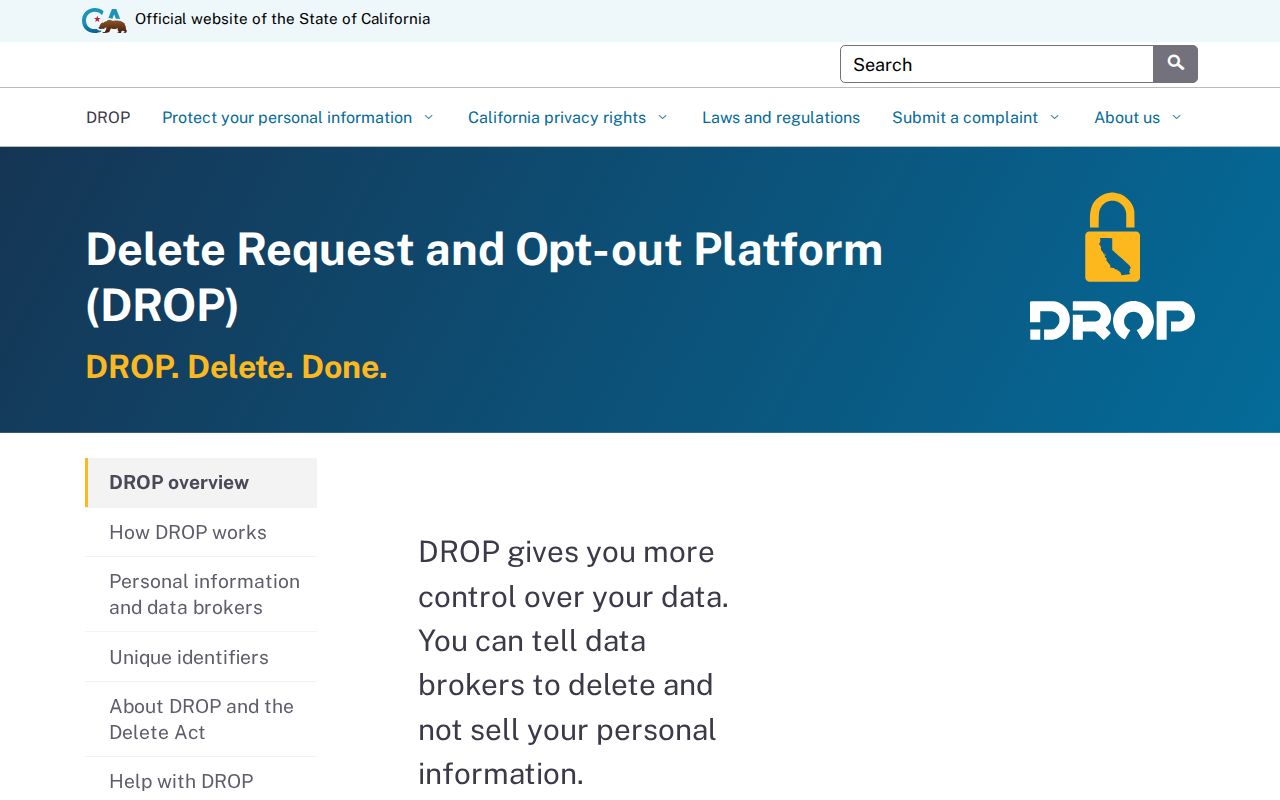
DROP changes covered broker copies, while the Ventura County custodian remains responsible for the original public record.
Lawful personal use. An Oxnard residents directory search is a research aid, not permission to evade a confidentiality program or expose someone who has a protected address. Verify with the custodian and stop when access is restricted.
For a practical privacy route, read the California DROP program instructions and the Secretary of State’s Safe at Home rules.
Oxnard’s Records History Leaves a Trail
Ventura County organized in 1873, and county birth, death, and marriage records begin in that year. California’s historical county-records guide describes early separate instrument books, general grantee indexes from 1916, and consolidated Official Records from 1920. The Ventura County Genealogical Society’s 1873-1917 grantee and grantor index can bridge early deed books. Oxnard’s townsite was platted in 1898 and the city incorporated in 1903, so a researcher should match the era of the question to the record system that existed then.
For older buildings, the Sanborn sequence of 1900, 1903, 1906, 1912, and 1929, with a 1929 edition corrected to 1950, can show footprints, uses, stories, materials, and outbuildings. City permits were not consistently required until the late 1940s, and the historic survey found missing files even for some buildings in the 1970s. A missing permit is therefore a prompt to compare a map, aerial, directory, deed, and newspaper, not a final answer.
That layered method is the durable meaning of the Oxnard residents directory: a present-day search can start with a parcel or name, while a past-resident search may end in a page, reel, map sheet, or deed book. Each dated source narrows the claim and makes the next record easier to find.
For current custody and access, the Ventura County Clerk-Recorder remains the primary county starting point.